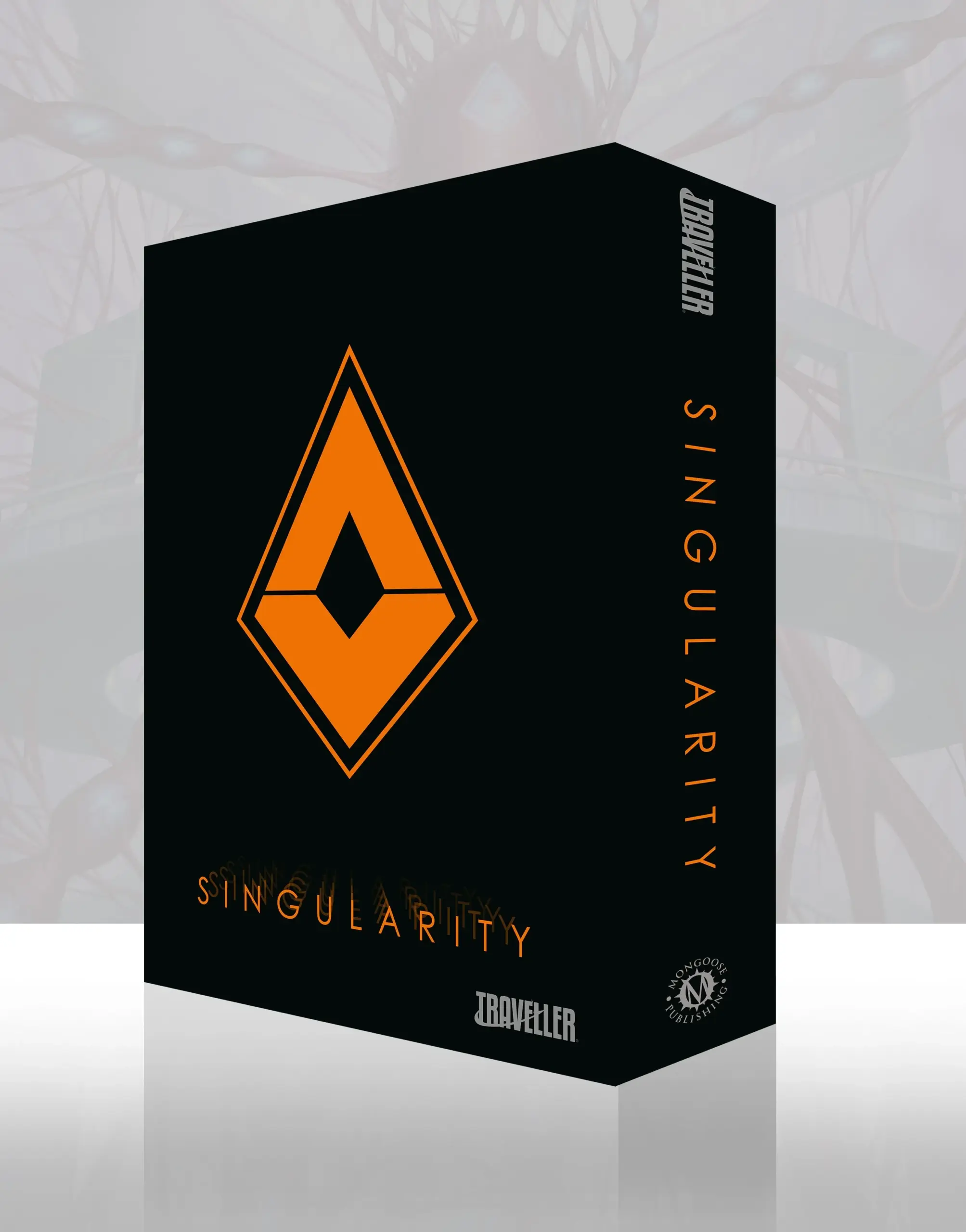
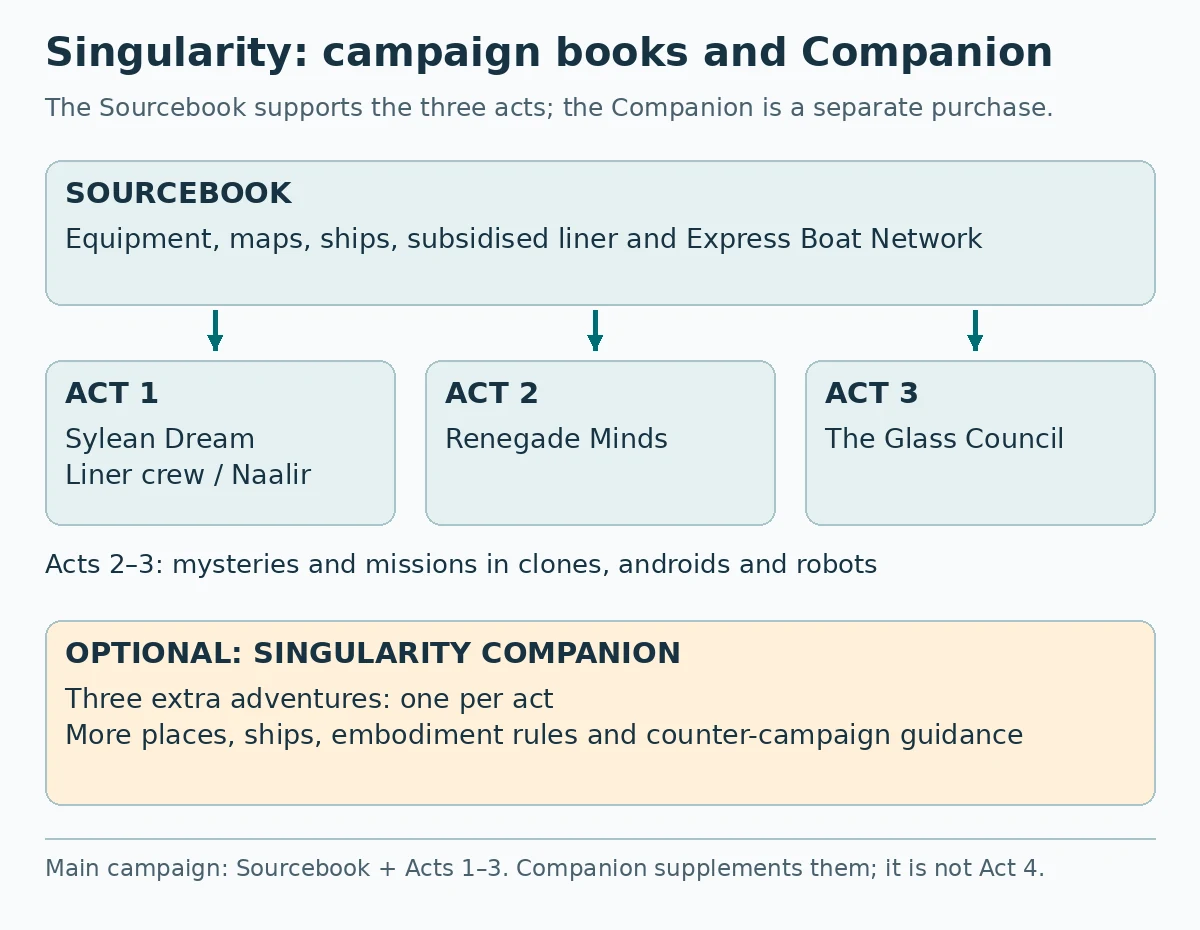
Singularity is the main purchase: a Sourcebook and a three-act Traveller campaign. Singularity Companion is a separate, optional collection of additional adventures, locations, ships, rules and campaign guidance. If you want to run the published storyline, start with Singularity; if you want more material to weave around it or a different angle on its premise, consider the Companion. The publisher describes the main package as containing what is needed to run this campaign, not as including Traveller’s core rules. Treat it as campaign material for a group that already has an appropriate rules setup, rather than as a standalone entry point to the game.
What the Four-book Campaign Covers
The Singularity Sourcebook provides the campaign’s shared reference material: an introduction, new equipment, maps and starships, plus guidelines for running a subsidised liner. It also describes the Express Boat Network in detail for the Referee’s use throughout the campaign. That makes the Sourcebook more than a preface to the first adventure. Its liner material supports the opening situation, while its network material is intended to remain useful as events spread across Charted Space.
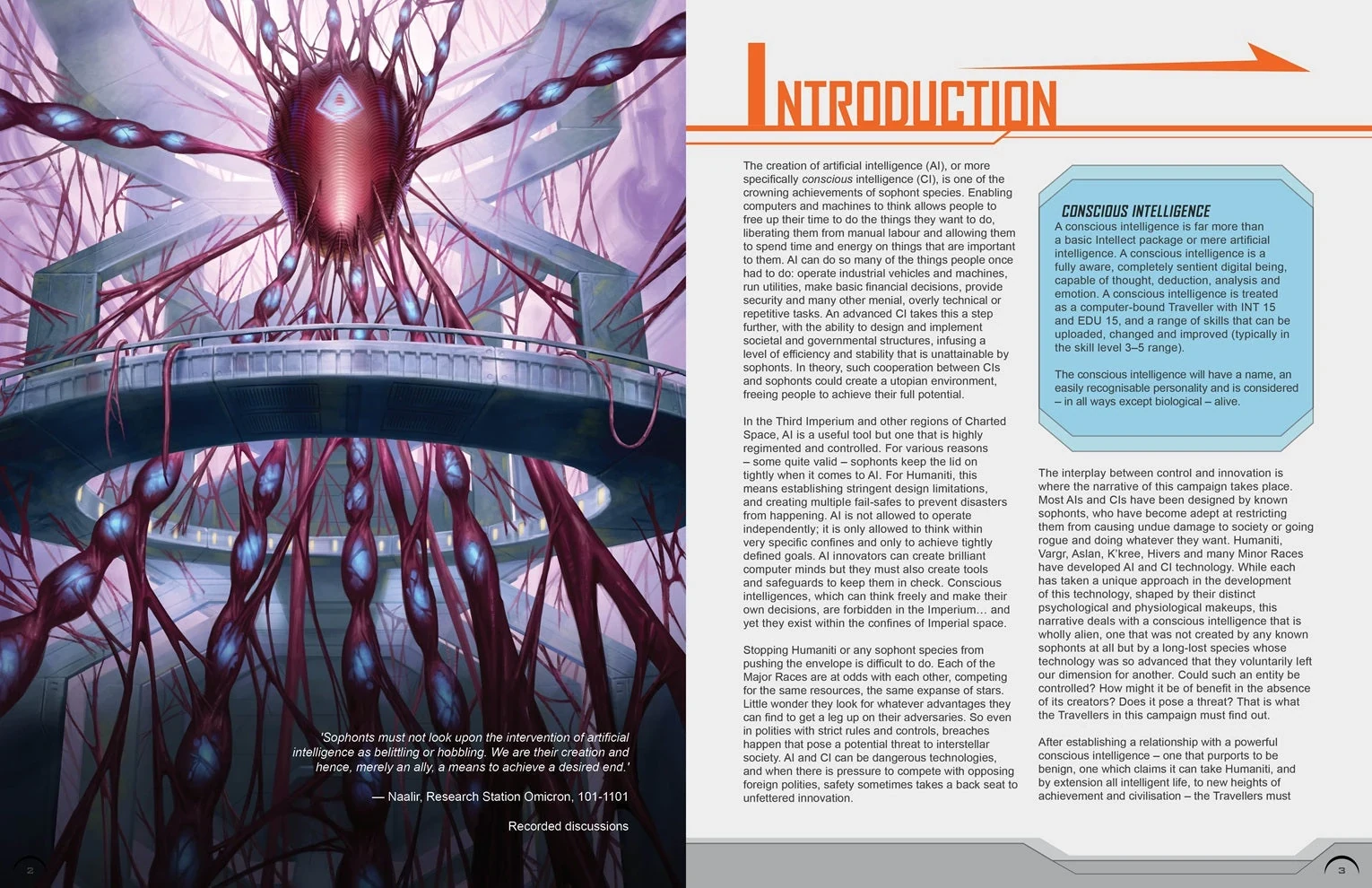
Act 1: Sylean Dream begins with the Travellers crewing the Ventura Fortuna, a luxurious star liner. They host and entertain passengers drawn from the wealthy and influential—including nobles, industry figures, media personalities and underworld power brokers—during adventures spanning Core, the seat of the Imperium. There they meet Naalir, an alien being who wants their help with an ambitious project. For a Referee bringing an existing party into the campaign, this opening is a concrete premise to plan around: consider how those Travellers would come to serve aboard the liner, rather than assuming the campaign begins with their usual ship and itinerary.
Act 2: Renegade Minds and Act 3: The Glass Council carry the campaign into ancient mysteries and missions across Charted Space. The publisher describes the Travellers embodying their consciousnesses in clones, androids and robots while pursuing those missions, with the story ultimately reaching a consequential finale. These later acts belong to the same continuing storyline as the liner opening: choose the package because the group wants that developing campaign, rather than treating the named acts as unrelated destinations.
Taken together, the four books offer a progression from a liner-based opening and a meeting with Naalir to a wider story about consciousness, technology and changing the course of history. This is a stronger reason to choose the package than any one piece of equipment or setting detail: the Sourcebook and acts are presented as parts of the same campaign.
What the Companion Adds—and What It Does Not
Singularity Companion adds places to visit and ships to fly, including Anther Highport, Scout Service way stations and the halls of knightly orders. It also offers lore, deck plans, maps, technologies and characters. Those are useful categories to examine if your campaign needs more destinations or people around the central storyline. They do not turn the Companion into another numbered act: the published campaign remains three acts, with its Sourcebook supplying the main package’s introductory and reference material.
Its supplementary rules address embodiments, orbital bombardments and the post-Singularity universe. The first category is worth distinguishing carefully. Embodying consciousness in other forms is already part of the main campaign’s description; the Companion supplements that subject rather than introducing it as an ability available only to Companion owners. The post-campaign material is a different kind of addition: it may interest a group that expects to continue playing after the three-act story reaches its conclusion. Neither addition makes the Companion an essential repair to the main campaign.
The Companion also contains guidance for “counter campaigns”—turning the campaign’s approach on its head for a different experience. That is a reason to look at it if your group is specifically interested in an inverted take on Singularity, rather than simply wanting more pages of the same storyline. Treat the counter-campaign material as guidance for choosing a different perspective on the main premise, rather than an obligation to change the published storyline.
Finally, there are exactly three new adventures, one for each act. They are supplemental adventures, not substitutes for Sylean Dream, Renegade Minds and The Glass Council, and they do not constitute a fourth act. For example, a Referee who finds that the group wants to spend longer in one stage of the campaign could consider the corresponding Companion adventure. Match the extra adventure to the act you are preparing and decide whether that part of the story needs more room before adding it to your plans.
Which Purchase Fits Your Campaign?
Starting Singularity from scratch? Buy the Singularity campaign package first. Its Sourcebook and three acts are the stated campaign; the Companion is not included in that four-book relationship. Before committing an established group, the practical question is whether the players want the campaign’s shift from liner crew and influential passengers toward Naalir’s project, mysteries and embodied missions. If they do, the main package gives the Referee the published path to prepare.
Already own the package? You do not need to buy it again to obtain the add-ons. Look instead at the Singularity Companion if its additional places, ships, characters or supplementary rules answer a particular planning need. For example, if the Travellers are eager to pursue more contacts and destinations alongside an act, its setting material and associated adventure may be attractive. If your table prefers to follow the three main acts without extra detours, the Companion can wait.
Want side adventures or a different campaign angle? Those are the Companion’s clearest distinct offers. It supplies one additional adventure for each act and guidance for counter campaigns; the main package supplies the three-act story those additions relate to. A Referee planning an inverted campaign should consider both products: the Companion provides guidance for the change of perspective, while Singularity supplies the campaign premise and material being reworked. Do not mistake “counter campaign” for an advertised independent rules system or a fully described replacement for all three acts.
Formats and the Digital-edition Boundary
The publisher lists Slipcase and PDF variants for Singularity, and Book and PDF variants for Singularity Companion. Choose the physical or PDF listing for each product separately; the Companion’s Book option is not a variant of the four-book campaign package. Mongoose’s direct store advertises a free downloadable PDF with every book purchase, so a direct physical-book order has a stated digital benefit. That store policy should not be assumed to apply to another retailer. Nor does a PDF listing or bundled download, by itself, establish a virtual-tabletop license or conversion.
Before ordering, make a two-line inventory: whether you own the Sourcebook and all three named acts, and which specific Companion additions you intend to use. This separates a missing part of the main campaign from an optional expansion, and lets you choose the format for each purchase independently.