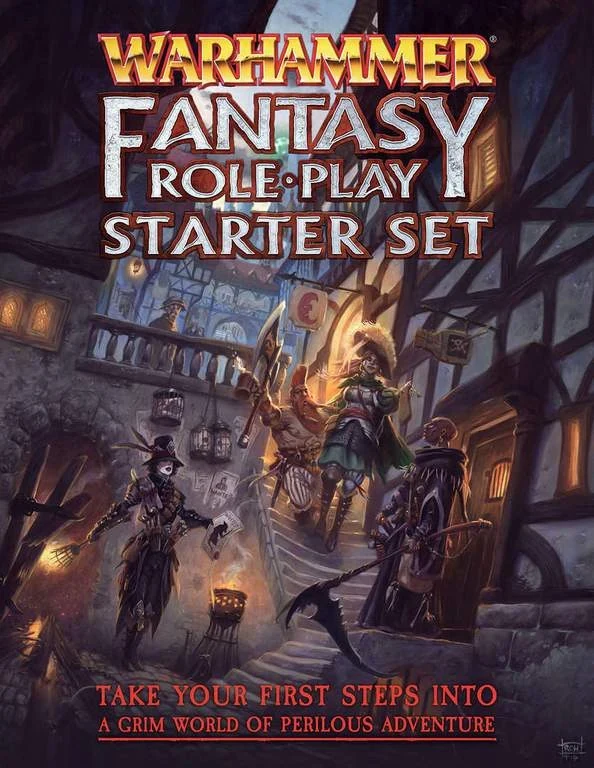
Finishing the Starter Set’s teaching adventure does not make its Ubersreik material redundant. Keep the city guide, maps, characters, and remaining adventure material; add the fourth-edition Core Rulebook when you want the fuller framework for your own characters and continuing play. The separate Gamemaster’s Screen answers another need: reference material and GM tools, rather than another introductory adventure.
These products do different jobs. The Starter Set supplies a guided way into the game and a substantial place to keep playing. The Core Rulebook supplies the wider rules and character options. The separate screen and its guide support the GM’s work during and between sessions. Choosing the next purchase is easier when you identify which of those jobs your group needs next.
This comparison concerns the fourth-edition products: Starter Set CB72401, Core Rulebook CB72400, and Gamemaster’s Screen CB72404. Match the edition and product when adding to a collection, particularly when a shop also carries other Warhammer roleplaying games or editions.
What the Starter Set Provides for the First Game
The Starter Set combines adventures, rules introduction, setting material, and table components. Making the Rounds is the teaching adventure: Cubicle 7 describes it as introducing Ubersreik and taking players step by step through the rules. The Adventure Book also advertises ten scenarios for expanding play with more locations, characters, and dangers. Those remain part of the set’s value after the introductory teaching sequence.
| Starter component | Its continuing use |
|---|---|
| Making the Rounds | A guided introduction to the game and Ubersreik |
| Additional advertised scenarios | More situations to run beyond the initial teaching material |
| A Guide to Ubersreik | A continuing city setting with locations, people, factions, and hooks |
| Six ready-made character portfolios | An established cast to continue using or draw into later stories |
| Maps and handouts | Geographic and player-facing material to keep with the campaign |
| Dice, Advantage tokens, and references | Physical play aids that can remain useful alongside the core rules |
The publisher lists a 64-page city guide, more than seventy locations, and two adventure hooks for each entry. That is more than a short backdrop explaining where the first encounter happens. It gives the GM material to return to as the group makes connections and chooses what to investigate next.
There is a page-count inconsistency worth checking when comparing copies: the product description calls the Adventure Book forty pages, while the same listing’s specification gives forty-eight. Neither number establishes a different adventure package by itself. Check the actual component in the copy you are buying, particularly in a used set, rather than assuming an unexplained difference means extra scenarios. The 64-page Ubersreik guide is listed separately.
Why the Ubersreik Guide Outlasts the Teaching Adventure
The guide describes the city’s history, its recent invasion, surrounding fiefdoms, and antagonist cults, alongside its locations. These give a continuing campaign several kinds of material: places the characters know, institutions they can deal with, and pressures that can drive further adventures. The introductory adventure can teach the rules without exhausting that setting.
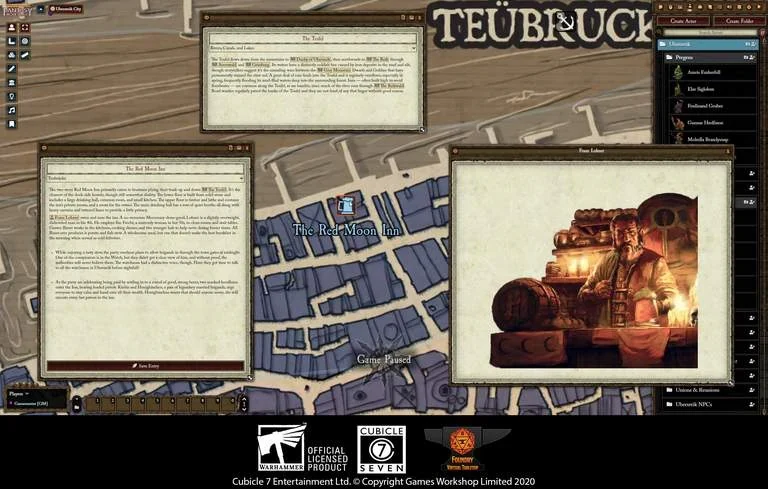
A city guide is especially useful when the group decides to revisit somewhere. A location can become familiar before it becomes important to another investigation. Its staff, customers, or political associations can give a return visit a different purpose. That is an application of the guide’s setting material, rather than a requirement to discard a location once its first hook has been used.
The publisher’s Foundry illustration makes this concrete. It shows the Red Moon Inn located on the Ubersreik map, with a location entry and an NPC illustration alongside it. The image is a view of the separately supplied virtual-tabletop adaptation; it helps show how the city’s places and people relate, without making that software an entitlement of the physical box.
Keeping a city base also helps organise preparation. You can choose the entries relevant to the group’s current interests, note what has changed through play, and develop connections between them. More than seventy locations provide a range of choices, not a requirement to tour the whole city before moving on. The guide’s surrounding-area material likewise offers room to look beyond one street without abandoning Ubersreik as a familiar point of return.
A Location’s Two Hooks Are Starting Points for More Play
The two hooks attached to an entry turn setting description into things the GM can offer the group. They are useful prompts, rather than two complete, fully developed adventures for every location. Counting locations and multiplying by two would therefore overstate the number of finished scenarios in the box.
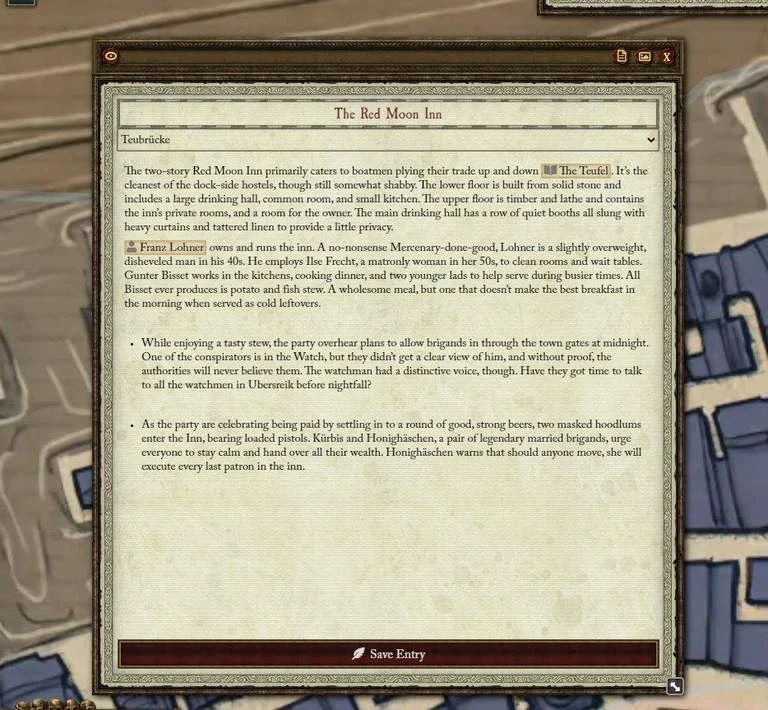
The actual Red Moon Inn entry demonstrates the difference. It first describes a dockside inn serving traffic on the Teufel, including its rooms and owner. Its two hooks then introduce different situations: overheard plans involving a member of the Watch, and an armed robbery during a celebration of the party’s pay. The same place can support more than one kind of trouble.
A GM could choose one of those situations, decide who is present, and prepare how the people involved respond to interference. That still leaves room for the players’ decisions. The hook does not promise that the group will follow a single route or reach a predetermined ending, and the location description does not do all the work of developing the situation into a session.
This is why the guide and the Adventure Book complement each other. The book offers the advertised scenarios and teaching structure; the city entries offer further places, relationships, and prompts. Someone who already has the Starter Set need not buy another book merely to obtain a new tavern or another reason for trouble to arise in Ubersreik. The more useful question is whether the next stage of play needs broader rules, more prepared adventure material, or additional GM reference tools.
What the Core Rulebook Adds
The Core Rulebook supplies the wider game framework. Its listing offers Humans, Dwarfs, Elves, and Halflings; sixty-four careers; religions and priestly miracles; spells from eight magical traditions; a bestiary; and GM advice. It also covers combat, pursuits, diseases, and other misfortunes. Those are reasons to add the core beyond simply replaying the Starter’s introductory sequence.
Careers matter to the longer-term character decision. The publisher describes a career as a character’s way of life when not adventuring, so the choice concerns their place in the world as well as what they do during a confrontation. A group wanting to create its own people, develop their careers, and choose a broader range of roles has a different need from a group beginning with the supplied cast.
The magic and religion material broadens another part of that framework. A GM and players considering magical or priestly characters need the relevant options and rules, rather than assuming the introductory handling of one supplied character represents the entire game. The bestiary and wider misfortune rules likewise support situations beyond the ones selected for teaching.
The core does not perform the same job as the Ubersreik guide. General character and game rules do not make your existing city entries, maps, and local hooks unnecessary. Keep the set’s material alongside the rulebook and use each for the question it answers: the rules for how the game handles a situation, the setting material for the people and places involved.
Keep the Supplied Cast, but Understand Its Starting Experience
The Starter characters can remain useful when you move to the fuller rules. Cubicle 7 published a Character Pack presenting complete profiles for the six in standard WFRP form, with a specific warning: they are more experienced than a normal starting group. The pack’s introduction states that each has accrued 2,200 XP, and it asks GMs to consider differing Status and Career Levels.
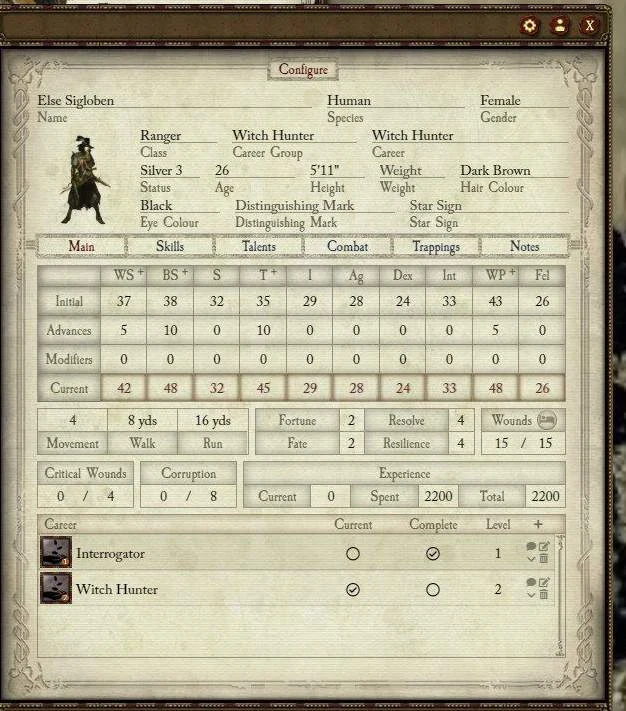
The native Else Sigloben interface illustrates the point. It shows a filled character with Initial, Advances, and Current values, career rows, and experience fields. Its XP display has 2,200 spent and zero current, rather than 2,200 waiting to be spent again. This is the publisher’s Foundry presentation of a filled character, with the career and advancement information visible together.
Treat that established experience as part of the group you are choosing to continue. Adding the core does not, by itself, call for replacing the characters or treating them as newly generated beginners. If you prefer to rebuild less experienced versions, the pack’s introduction describes that option too. Discuss the intended starting point before combining established characters with newly created ones.
The cast can also be useful if the players decide to make new characters. The publisher explicitly suggests the six can serve as NPCs. That preserves familiar people from the introductory material without requiring every later campaign to use the same protagonists.
Custom Characters and Broader Rules Answer a Different Need
Creating a new party is a good reason to bring the core into the decision early. It supplies the broader character options and the game’s continuing rules, while the Starter provides a ready-made way to begin. Those are different kinds of convenience: choosing an established character gets play moving; choosing your own background and career gives the group another set of identities to develop.
If the group wants to remain in Ubersreik with new characters, the setting material can stay. Establish why those people are in the city, what brings them together, and which of the available situations interests them. Those are campaign-preparation choices; buying the core does not require starting in another region or making the existing guide irrelevant.
Likewise, keep the teaching adventure’s purpose separate from the rulebook’s purpose. The Starter explains rules through selected situations. The core is the reference for the wider subjects its listing identifies, including pursuits, diseases, religion, and magic. It is the appropriate addition when your questions expand beyond the introductory material’s chosen path.
That distinction also helps an experienced GM assessing the set from the other direction. Already owning the core does not mean the Starter’s local setting and adventure material have no use. You may be buying the city, its prepared cast and situations, and physical aids rather than needing another introduction to the basic activity of roleplaying.
Where the Separate Gamemaster’s Screen Fits
The separately sold Gamemaster’s Screen provides a four-panel standing screen with common rules, tables, and NPC aids. Its accompanying Gamemaster’s Guide is a 32-page booklet with advice, optional rules, and random tables. The publisher identifies themes, techniques, keeping players challenged, and expanded discussion of Combat, Advantage, and Motivations among its subjects.
That makes it a GM-support purchase. A screen can keep frequently consulted information at hand and conceal material from the players. The guide adds preparation and running advice, optional ways to streamline large combats, and tables covering such subjects as Doomings, Motivations, and adventure seeds. These serve a different need from the core’s character options or the Starter’s developed local setting.
The Starter listing already mentions a Gamemaster Screen and rules references among its aids. Do not assume that this means the separate product’s four panels and full accompanying guide are already included, or that the two items have identical contents. Compare what your box supplies with the separately described package.
The separate screen need not be the first addition for everyone. If you need the full character and game framework, prioritise that need. If you already have the rules and want better access to references or more GM tools, the screen package answers that more specific requirement. Its optional rules and seeds should not be mistaken for another full Ubersreik campaign or a substitute for the core.
Check Physical Components and PDF Offers Separately
The Starter specification lists six gatefold character sheets, seven handouts and reference sheets, forty-nine Advantage tokens, four maps, and two custom Q WORKSHOP dice, alongside its books. Those are useful checks when assessing a physical copy. Keep the printed aids that your group uses; adding a hardback does not remove the purpose of dice, maps, or player-facing references.
For a used set, compare the actual contents with the listing. A city guide alone is not a complete boxed set, and a PDF of a map is a different deliverable from the printed component. The Adventure Book’s inconsistent forty/forty-eight-page listing is another reason to inspect the actual books rather than decide completeness from a seller’s short title.
The Cubicle 7 product descriptions also identify PDF offers. The Starter and core listings say direct purchases include a PDF; the separate screen listing describes a DriveThruRPG redemption link in the order-confirmation email. Keep those promises tied to the specified offers, rather than assuming every retailer or second-hand purchase includes a transferable digital entitlement.
The screenshots used here depict the publisher’s Foundry adaptation of Starter material. Its own listing says the WFRP Core Module is required for full functionality. Those software conditions belong to that separate package; they do not turn the physical Core Rulebook into a Foundry activation or make a virtual-tabletop module part of every Starter box.
Choose the Addition That Fills Your Actual Gap
| What you already own | What to keep using | What to assess next |
|---|---|---|
| Starter Set only | Ubersreik guide, adventures, maps, cast, and table aids | Core Rulebook for broader character creation and continuing rules |
| Core Rulebook only | The full game framework | Starter material if you want its Ubersreik setting, prepared situations, and components |
| Starter and core | The city and adventures alongside the wider rules | Separate screen package if references and GM tools are the missing need |
| Neither | Choose a starting format around the group | Guided Starter beginning or the full core framework; they offer different contents |
| Rules and setting already covered | Existing campaign material | Screen and guide only if their particular references, advice, and optional tools are useful |
For a group that enjoyed the Starter, the practical next step can be modest: retain the city and characters, choose which unused situation to develop, and add the core for the wider rules you now want. The existing material becomes a continuing campaign resource rather than a box to retire after the tutorial.
Compare the exact official Starter Set, fourth-edition Core Rulebook, and Gamemaster’s Screen offers. If you are keeping the supplied cast, the publisher’s Character Pack announcement explains why experience, Status, and Career Level deserve attention during that transition.