Choose by the part of your Monster of the Week campaign you want to develop. Mystic Marginalia is the most direct choice for a Keeper who wants prompts for mysteries and locations, or a group interested in troupe play and alternative ways to handle combat. Slayer’s Survival Kit is for players seeking new hunter archetypes and teams, with further options for Weird moves and equipment. Hunter’s Journal is for a group that wants an existing hunter’s personal story to become a structured part of play. Each can contribute to a continuing campaign, but they answer different questions; owning one does not make the other two necessary.
| If your immediate question is… | Start with… | Why |
|---|---|---|
| “What could this week’s mystery involve?” | Mystic Marginalia | Its random tables cover mysteries, locations, bystanders and villains. |
| “Who else could we play, and what binds this team together?” | Slayer’s Survival Kit | It adds nine hunter playbooks and nine team playbooks. |
| “How does this particular hunter’s past or identity drive an arc?” | Hunter’s Journal | It supplies customizable hunter-story frameworks for 33 official playbooks. |
Those are starting points, not exclusive uses. The details matter most when your group wants more than one kind of change.
Mystic Marginalia: Prompts, Troupe Play and Combat Alternatives
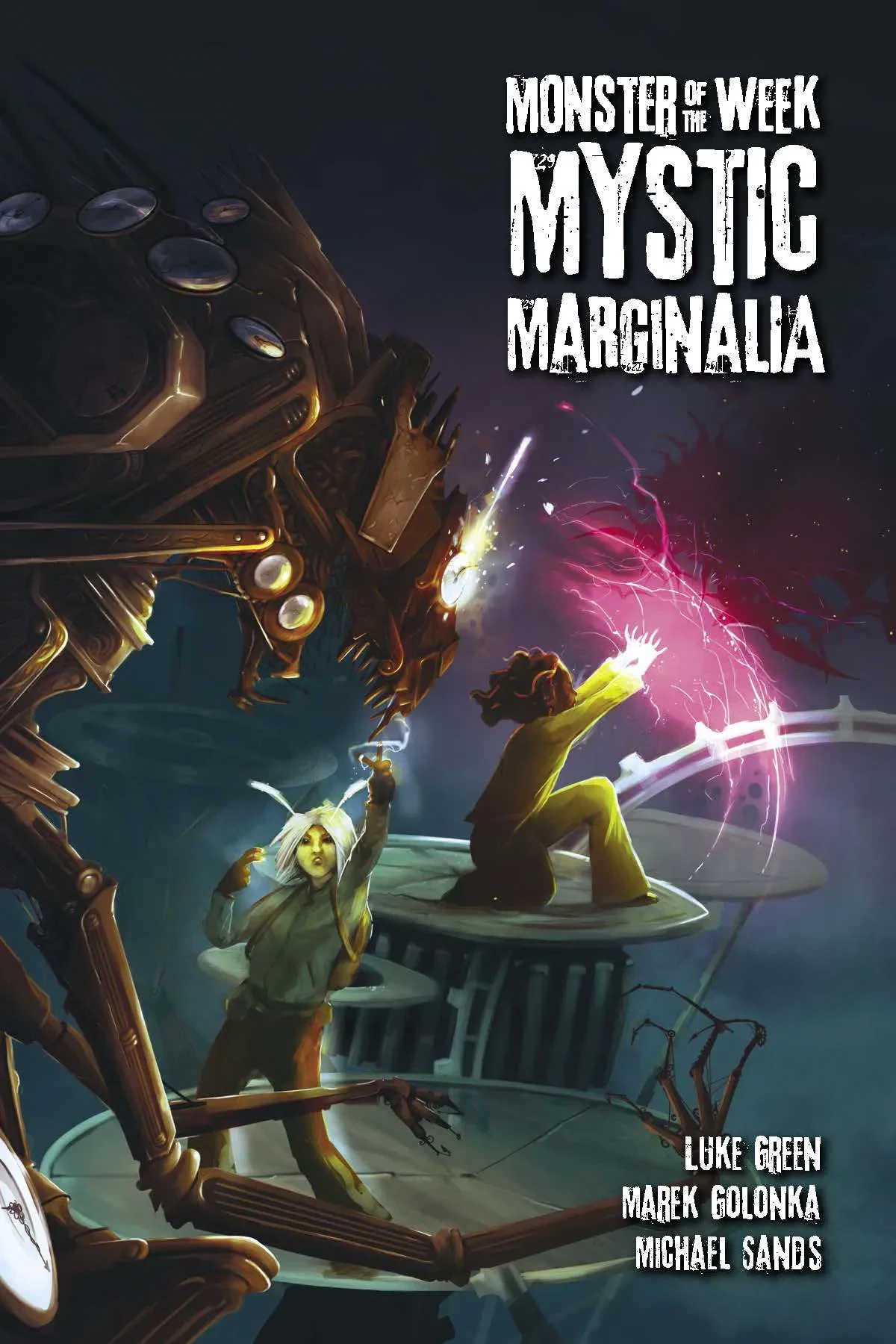
The 112-page Mystic Marginalia grew out of extras created for the crowdfunding campaign that funded Hunter’s Journal and Slayer’s Survival Kit. It is now offered publicly, rather than only to backers. Its largest stated component is 54 pages of random tables for generating mysteries, locations, bystanders, villains and other ingredients. That means pages of prompts—not 54 individual tables, and not 54 finished mysteries ready to run unchanged.
For a Keeper, the practical appeal is having several kinds of ingredient in one place. For example, if you already know a mystery’s central threat but cannot decide where its influence appears or who gets caught up in it, location and bystander prompts give you places to begin. You still decide which results fit the hunters, establish the situation and turn those ingredients into a mystery. If what you need is a prescribed personal arc for one hunter rather than prompts for the next case, Hunter’s Journal is the closer match.
Mystic Marginalia is not only a Keeper’s idea source. Its Ensemble Team playbook introduces troupe-style play in which players create at least two hunters each. Consider it if the group likes switching between members of a wider monster-hunting ensemble, rather than following one fixed set of individual protagonists. “At least two” leaves room for the group’s approach; it is not a requirement to stop at exactly two.
Players also get two hunter playbooks. The Abandoned can represent an urchin, a castaway or a sole remaining survivor. The Elemental is tied to a specific element or mineral; the publisher’s examples include Gold, Lead, Obsidian, Sapphire and Steel. Those are more specific character propositions than “more options” in the abstract. If one of them is the reason you are shopping, Mystic Marginalia may be the right pick even if you never use its tables or Ensemble Team.
Finally, its Alternative Combat Moves offer two changes in scale: zoom out to resolve a combat quickly, or zoom in on a tense one-on-one duel. That makes the book worth considering when the group wants different emphasis for different fights. The product description establishes those two approaches, but it does not lay out their procedures in enough detail to choose the book for a particular mechanical effect. Buy for the stated option to change combat focus, not an assumed damage, speed or balance result.
Slayer’s Survival Kit: More Hunters and a Shared Team Identity
The 240-page hardcover Slayer’s Survival Kit is the clearest choice when the group’s first request is new characters or a new collective premise. Its nine hunter playbooks are the Action Scientist, Celebrity, Changeling, Covenant, Envoy, Forged, Host, Interface, and Visitor. The publisher describes them as spanning fantastical folklore, paranormal fringe science and visiting aliens. If a player is drawn to one of those concepts, this is the expansion that actually introduces that playbook.
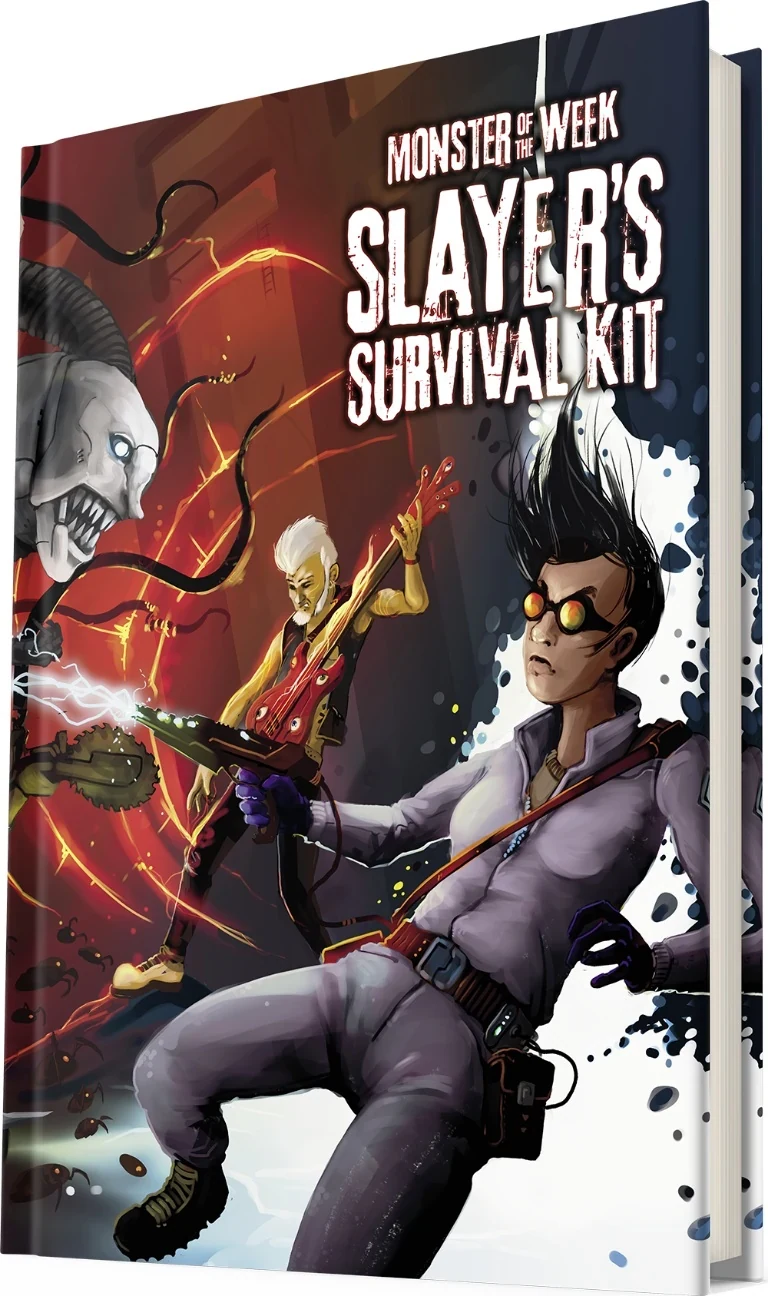
It also adds nine team playbooks. The named examples are the Artifact Collectors, Escaped Experiments, and Coven. A team playbook does more than supply a label: the publisher describes shared themes, new moves, special contacts and custom gear, alongside dedicated threats and mysteries. That combination is useful when players want their organization or common history to shape what happens, not just sit in a sentence of backstory. The available description does not name the other six team playbooks, so choose on the strength of the stated range and these examples rather than assuming an unlisted theme is present.
For example, a group planning to play survivors of a former experiment could look at the Escaped Experiments team concept before separately deciding which hunter playbooks fit its members. That is a different decision from Mystic Marginalia’s Ensemble Team: one concerns a shared team premise and its associated features; the other explicitly invites troupe play with at least two hunters per player. A group might like both ideas, but neither automatically supplies the other’s purpose.
The kit extends beyond playbooks. It includes new Weird moves, alternate rules for using Big Magic, arcane tools, bionics, cursed magic items and covert organizations. It also offers advice on building hunter playbooks, teams and Weird moves of your own. These give players and Keepers reasons to consult it after character creation, especially if the campaign’s supernatural methods or institutional connections deserve more attention. They do not make it a substitute for Mystic Marginalia’s stated random-table collection or Hunter’s Journal’s playbook-specific story frameworks.
If your group is content with its current hunters but feels its shared identity is thin, start by asking whether one of the kit’s team concepts is the change you want. If the real issue is that a particular established hunter rarely gets a meaningful decision about their own life, skip ahead to the Journal instead. More archetypes are valuable when someone wants to play one; they are not a prerequisite for giving an existing character more attention.
Hunter’s Journal: Make an Existing Hunter’s Story Matter
The 368-page hardcover Hunter’s Journal is built around hunter stories: personalized threats, entanglements and story beats connected to a playbook. It advertises two stories for each of 33 official hunter playbooks, explicitly including the nine introduced in Slayer’s Survival Kit. That works out to 66 story frameworks, not 66 complete, prewritten mysteries. Its premise is to give a particular hunter a consequential thread while the game remains about a team.
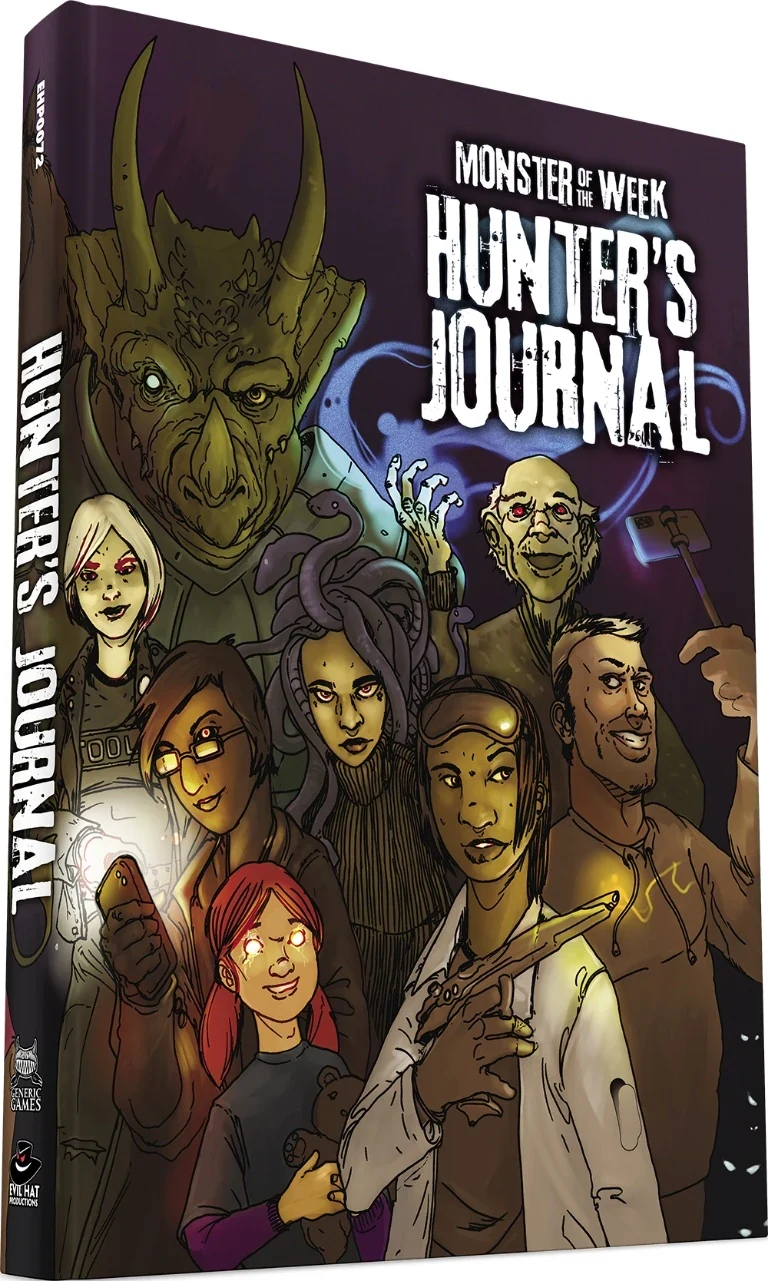
The publisher’s examples show the scale of that thread: a Chosen might try to escape their destiny, or a Professional might be headhunted by a rival agency. For each story, the hunter-facing tools include customizable entrances, choices and resolution moves. The Keeper-facing side includes threats, phenomena, locations and a countdown. This is why the book serves both sides of the table: the player can help decide what their hunter is confronting, while the Keeper has a framework for bringing that conflict into play.
For example, suppose a Professional’s player wants an offer from another agency to test their loyalties. The group could use the relevant hunter story to decide how that offer enters the campaign and what choices it puts before the character. The Keeper could then connect its threats and countdown to the mysteries already underway. The example is an application of the advertised framework, not a promise that the book writes your campaign’s particular agency or outcome for you.
The Journal also includes guidance for crafting and adapting hunter stories, advice on issues that arise in play, and hunter-specific principles for keeping team members engaged. That makes it useful even when a printed story is a starting point rather than a script. Its central purchase question remains straightforward: does your group want to spend play time exploring who an existing hunter becomes? If yes, this is more directly aimed at that goal than a book of new archetypes or mystery-generation prompts.
There is an important coverage boundary. The Journal explicitly includes stories for the nine Slayer’s Survival Kit hunters, but its description does not explicitly identify the Abandoned or the Elemental, the two hunters in Mystic Marginalia. Do not assume that its advertised count includes either one. If a story for one of those two is the deciding reason to buy, confirm that playbook’s coverage before ordering. Likewise, a Journal story for a Slayer hunter should not be mistaken for the full hunter playbook rules: choose the kit if you need to create and play that new archetype.
When Two Books Make Sense—and When One Is Enough
The most natural pairings follow the job each book does. A Keeper could draw a mystery’s people and places from Mystic Marginalia, then use Hunter’s Journal to make one hunter’s personal conflict intersect with that mystery. A group could choose a team premise and new hunters from Slayer’s Survival Kit, then turn to the Journal for a story involving one of those hunters. Or a group could combine the kit’s character options with Mystic Marginalia’s troupe approach if it actively wants a wider cast. These are ways to combine tools, not steps required by the expansions.
One book is often the cleaner purchase. An established team that needs next week’s mystery ingredients can start with Mystic Marginalia. Players who want different hunter and team choices can start with Slayer’s Survival Kit. A campaign happy with its current cast can use Hunter’s Journal for those hunters’ stories without buying the kit merely because nine kit playbooks are among the Journal’s stated coverage. Conversely, owning the kit does not create a need for a personal-story framework if the group does not want that emphasis.
Before combining books, name the change the players will actually notice. “We want more character concepts” points somewhere different from “we want to follow several hunters per player.” “We want a faster way to find a mystery premise” differs from “we want the Chosen’s destiny to become a sustained source of decisions.” Those distinctions prevent three compatible expansions from looking like three versions of the same purchase.
Editions, Formats and the Final Choice
The publisher lists Monster of the Week: Mystic Marginalia in Digital (PDF), Print on Demand, and Roll20 formats. It lists Monster of the Week: Slayer’s Survival Kit and Monster of the Week: Hunter’s Journal in Digital (PDF), Hardcover Book & PDF, and Roll20 formats. The publisher explicitly includes a PDF with each of the latter two hardcover purchases; it does not make the same bundle statement for Mystic Marginalia’s print-on-demand option. Select the format you intend to use rather than assuming a Roll20 edition comes with a print or PDF choice.
For most groups, the deciding question is not which book contains the most material. It is whether the next useful change is mystery prompts and optional ways to stage play, new hunters and team identities, or a structured personal arc for a hunter already at the table. Answer that question first, and the choice among Mystic Marginalia, Slayer’s Survival Kit, and Hunter’s Journal becomes much smaller.