If you have finished The Broken Tower and want to keep playing RuneQuest, you do not have to buy three successive versions of the same game. The free Quickstart gives you an abbreviated rules introduction and one complete adventure. The Starter Set is the next choice if you want guided play, ready-made adventurers and several more scenarios around Jonstown. The full RuneQuest: Roleplaying in Glorantha rules are the better next purchase if your group is ready to create its own adventurers and make their families, cults, magic and households part of a continuing campaign. You can go directly from the Quickstart to the full rules; the Starter Set is useful, not compulsory.
The distinction is less about how many sessions you have played than about what you want to do next. A group happy to pick characters and follow prepared adventures has a different immediate need from one whose players already have ideas for their own clan members, histories and magical commitments.
Start with the Free Quickstart If You Are Still Deciding
The RuneQuest: Roleplaying in Glorantha Quickstart collects the essential rules in abbreviated form. Its adventure, The Broken Tower, takes place in Dragon Pass and is suitable for up to five adventurers and one gamemaster. Chaosium offers the complete Quickstart as a free download, so a group that wants to try that adventure need not buy a rules product first. The publisher’s page also offers a physical copy with a PDF.
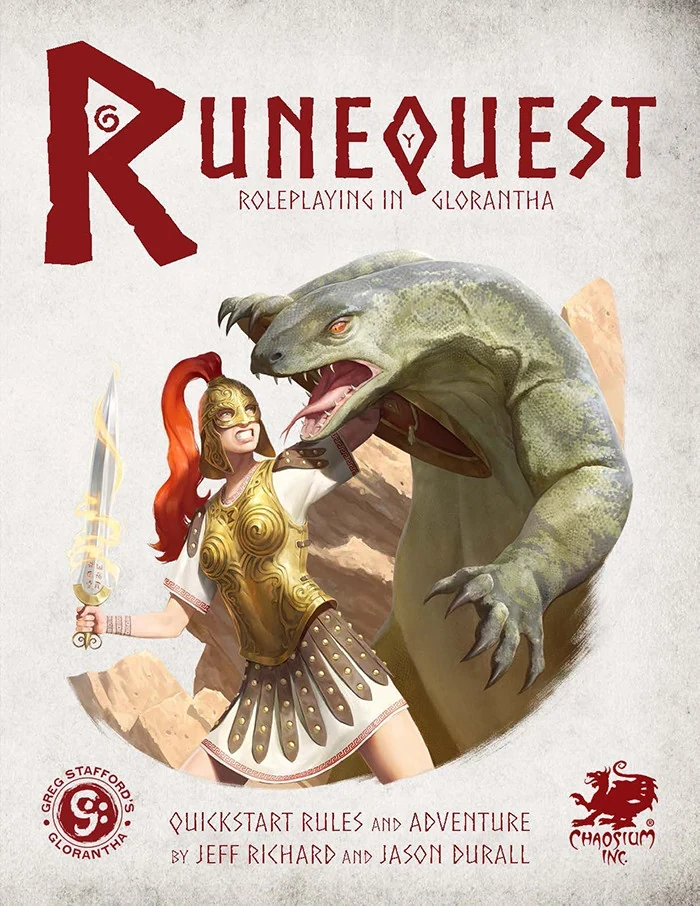
That “complete” download means the complete Quickstart, not the complete full rules. It gives the group what it needs to play The Broken Tower while presenting the system in a shorter form. Alongside the booklet, the download page provides adventurer files, an optional Assistant Shaman adventurer, player maps for the Colymar region and the Broken Tower, and print errata. If you are preparing the adventure, those files are worth checking before deciding that you need another book merely to run your first game.
Afterward, ask what actually held the group’s interest. If it was making decisions as the supplied adventurers and you would like another prepared situation, the Starter Set offers a clear next step. If players instead want to build people of their own—with chosen cultures, cults and family backgrounds—the full rules address that goal more directly. Neither preference makes the Quickstart a wasted first step: it let the group learn what it wants from further play without an initial purchase.
Buy the Starter Set for Guided Play and More Adventures
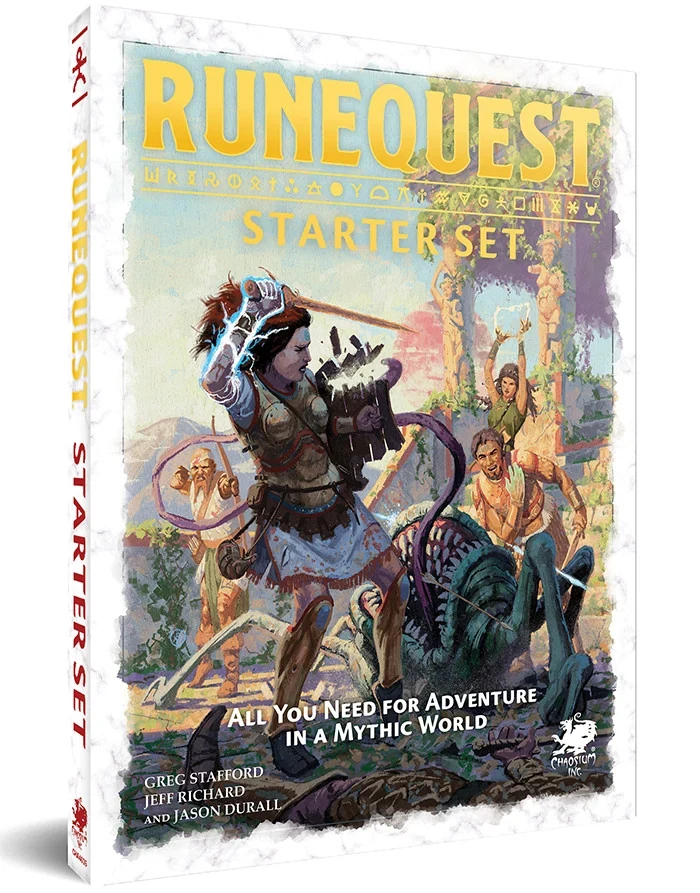
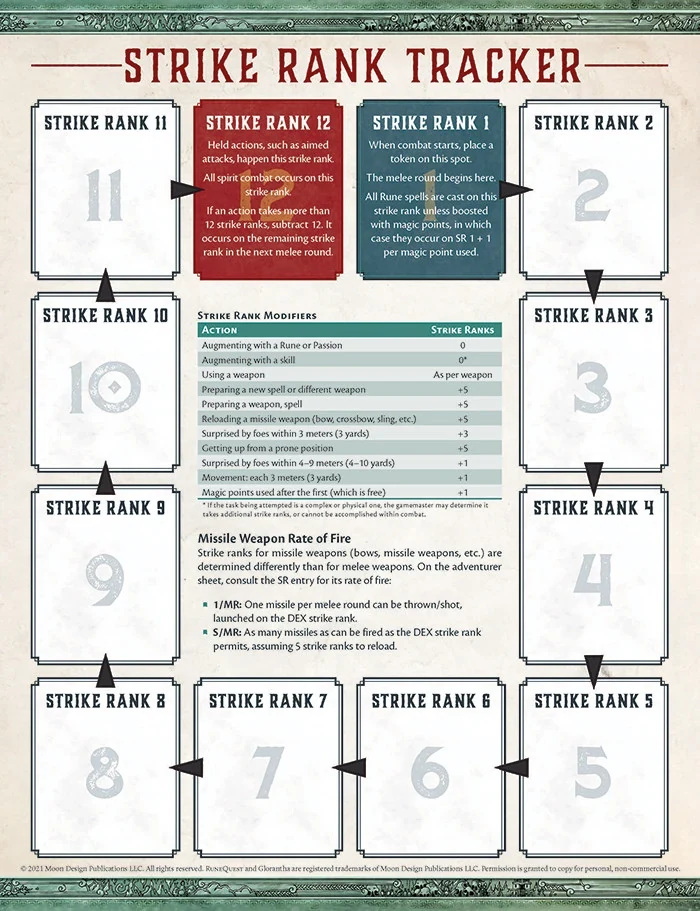
The RuneQuest Starter Set is a box for groups that want to continue playing with supplied characters and structured material. It contains four softcover manuals covering rules, setting and scenarios; 12 pregenerated character folios; dice; maps of Jonstown and its surroundings; and a Strike Rank Tracker for combat. The publisher says the box contains enough material for several sessions, and its physical-copy offer includes a PDF. It is a distinct paid product, not the free Quickstart in another format.
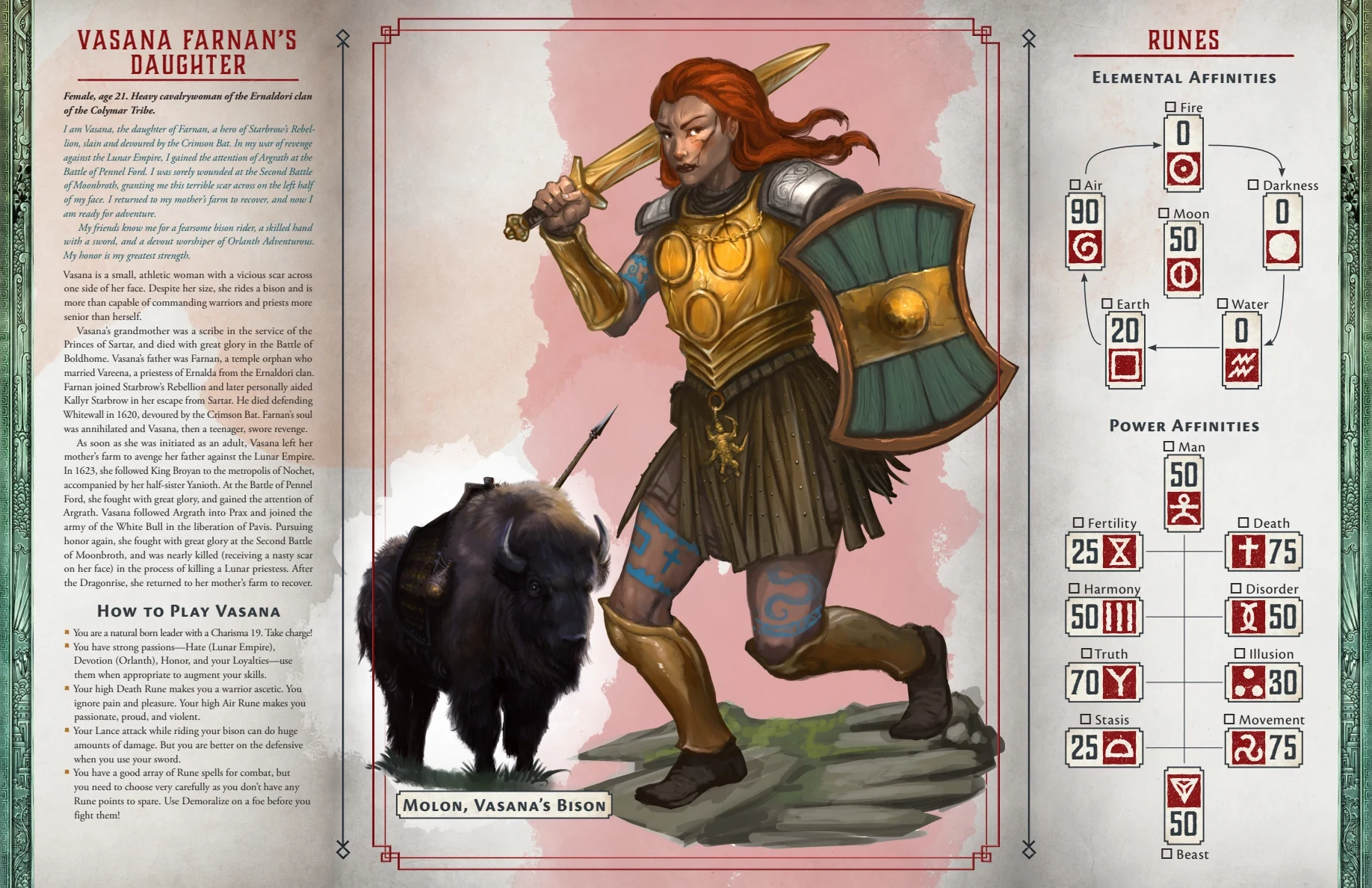
Its teaching adventure and group adventures do different jobs. The Battle of Dangerford is a single-player SoloQuest: you play Vasana during a clash with the Lunar Empire and learn rules through play. It is not one of three group scenarios, nor do the 12 character folios represent 12 separate adventures. The three scenarios that follow are designed for up to five players. A gamemaster can therefore use the solo experience to get oriented, then bring a group to the table with a choice of prepared adventurers.
Choosing a Ready-made Adventurer
This is the Starter Set’s practical appeal after The Broken Tower: it reduces the amount the group must invent before the next session. Players can choose among established backgrounds and playstyles instead of pausing for full character creation. The Jonstown-area maps and scenario-specific maps and notes give the gamemaster locations to work with. If a player becomes attached to a folio character, buying the full rules later does not make that character, the maps or the scenarios irrelevant. The Starter Set supplies adventures to play, while the core book supplies a broader framework for developing a campaign.
You also need not treat the Starter Set as a prerequisite for every Jonstown story in it. The box presents its own rules, dice, folios and scenarios as playable material. Its value is the combination of guidance, physical aids and prepared play—not an obligation to purchase it before you are allowed to use the full rules.
What the Three Starter Set Scenarios Offer
The group adventures are distinct situations rather than repetitions of the Quickstart’s Broken Tower. In A Rough Landing, the adventurers come from the Battle of Dangerford into trouble with aggressive dark trolls and a problem in a nearby farming community. That makes it a natural follow-on if your group has used the Starter Set’s solo introduction and wants to move into shared play. It does not mean every player must individually play through the SoloQuest before the group can begin.
A Fire in the Darkness changes the immediate task to investigation. A series of fires in Jonstown leads the adventurers toward tunnels beneath the city. The description explicitly raises doubt about the apparent suspects, so it is a good choice when the group wants to follow clues and question an obvious explanation rather than simply seek a fight. The Jonstown maps give that investigation a place within the Starter Set’s wider local material.
The Rainbow Mounds sends the adventurers into a mysterious cave complex after trolls threaten a nearby village. Its tunnels lead to an unexpected foe. Together, the three scenarios offer a farming-community problem, a town investigation and an underground expedition. That range is a concrete reason to buy the box if the gamemaster’s immediate question is “What can we play next?” rather than “How do we create our own long-term cast?”
The Starter Set does not require you to commit to an indefinite Jonstown campaign. But if the group likes the location, its maps, character folios and connected starting situations can give you recurring people and places to build on. For example, a gamemaster might let a community encountered in one scenario become a source of later requests. That is a campaign choice, not another adventure promised in the box.
Choose the Full Rules When the Campaign Becomes Your Own
The full rules product is RuneQuest: Roleplaying in Glorantha – Hardcover. This is the purchase to prioritize when players want to move beyond selecting a prepared folio. Its character-creation rules cover family history, core traits, culture and cult: decisions that place an adventurer within Glorantha rather than assigning a conventional fantasy class. RuneQuest uses percentile rolls, and the publisher describes characters through their cultures, gods and Runes, without character classes or alignments. The physical-copy offer includes a PDF.
That changes the questions players can bring to the table. Instead of asking only which supplied adventurer to take into the next scenario, a player can ask what happened to their family, where they belong, and which god they follow. The cult choice matters beyond a label: cults shape followers’ skills, spells and personalities. The core rules also describe advancement through using skills and abilities during play. These are useful tools if the group expects its characters’ choices and experiences to carry forward.
Magic is another reason to make the move. The full rules describe Rune, Spirit and Sorcery as three distinct magic systems. A group that has enjoyed using the abilities on prepared folios may want the wider rules when it begins choosing adventurers’ cults and exploring different magical paths. The point is not that everyone must master all three systems at once. It is that the core book gives a developing campaign room to make those choices rather than relying solely on the starting selection of characters.
For a long-running game, the strongest difference may be what happens between adventures. The full rules cover farming, managing households, marriage, raising children, family trees and familial legacies. They support a campaign in which a battle or investigation has consequences for a home and its next generation, not just for the next outing. For example, a player whose adventurer returns to a farming household could make that household part of the story instead of treating it as an unexplained source of supplies.
Owning the core book does not mean you must discard the Starter Set. You can keep using its pregenerated folios, Jonstown material and scenarios while deciding when to introduce newly created adventurers. The full rules add the character-creation, magic and ongoing-life material for a campaign your group develops further.
For a retail print alternative, RuneQuest: Roleplaying in Glorantha on Amazon is the matching English hardcover core book. Compare its current buying options with the publisher’s direct book-and-PDF offer; the retail listing alone does not establish that PDF entitlement.
A Sensible Route for Your Particular Table
Still unsure whether RuneQuest is for you? Download the Quickstart, use its adventurers and maps, and play The Broken Tower. Its abbreviated rules are intended for precisely that immediate start. If the group stops there, you have not bought a larger package in anticipation of a campaign that never began.
Want the next sessions ready to run? Pick the Starter Set. The SoloQuest can help someone learn through play; the three group scenarios, character folios, Jonstown maps, dice and tracker give the table more to use afterward. This is the route for a group that wants time with RuneQuest before undertaking its own character creation and campaign planning.
Already planning original adventurers and a lasting home for them? Go from the Quickstart straight to the full RuneQuest: Roleplaying in Glorantha rules. Buy the Starter Set as well only if you want its particular scenarios, folios, guided introduction or table aids. Conversely, a group enjoying the Starter Set can continue with that material before deciding it needs the full creation and household rules. There is no required three-product buying sequence.
Beyond these choices, follow the gap your campaign actually develops. Chaosium describes the Glorantha Bestiary as offering more than 180 creatures and additional playable peoples, while its Gamemaster Screen Pack adds scenarios, setting information, reference tables and maps. Those are possible later complements, not substitutes for the Starter Set’s specific adventures or the core book’s character and campaign rules. None is a reason to assume the full rules alone contain every future adventure your group might want.